As soon as electric heating in a home is mentioned, one image almost always comes to mind: the old convector that heats poorly, dries out the air and drives up the bill. The infamous “toaster”. This reputation is stubborn, and it keeps causing worry: a future occupant who hears “electric heating” often dreads a hefty bill.
Yet this fear rests on a comparison that no longer holds. The electric heating of the 1980s, installed in a poorly insulated home, has almost nothing to do with a high-performance appliance fitted in a new-build home designed to today’s standards. Between the two, everything has changed: the regulations, the insulation, the very design of the buildings. So let’s set the record straight, and look at what really drives a home’s energy consumption.
Where does the “toaster” image come from?
The idea that “electric radiator = energy sink” comes from a specific era. In older, poorly insulated homes, heat escaped through the walls, windows and roof almost as fast as it was produced. To maintain a comfortable temperature, the heating therefore had to run almost non-stop to replace that lost heat, and the more heat an appliance produces, the more it consumes. The bill went up. This was true for every type of heating: in an energy sieve, the whole building is to blame, not just the appliance. But electric heating crystallized this bad image, with imprecise convectors that heated unevenly and gave a dry-air feeling, often prompting people to turn the settings up.
This is also why most studies and discussions about energy savings focus on renovation. In an energy-inefficient home, changing one piece of equipment can make a real difference, because the home wastes so much energy that there is a great deal to gain. But these results cannot be transposed as-is to a new-build home: the starting point is not the same. Comparing a new apartment to a 1980s home simply no longer makes sense.
In new builds, the envelope makes the savings
The first thing to understand is that in a new-build home, most of the energy performance is decided before we even talk about heating. It is decided in what is called the building envelope: its ability to keep heat inside.
Since 2022, every new build in France is subject to RE2020 (the 2020 Environmental Regulation). It aims to reduce the energy consumption of new buildings and to limit their carbon emissions. And one of its very first indicators, the Bbio (bioclimatic requirement), specifically assesses a home’s heating, cooling and lighting needs independently of the equipment installed. In other words: before looking at which radiator to fit, the regulation checks that the building itself is designed to need very little energy.
Several levers feed into this calculation, and they are the ones that truly deliver the savings:
- Insulation of the walls, roof and floors, which limits heat loss.
- Airtightness, which prevents leaks and draughts.
- Orientation of the building and rooms, to make the most of free solar gains (living spaces facing south, for example).
- Glazed surfaces and window quality, whose performance and size are designed to capture heat in winter without overheating in summer.
- Thermal inertia and solar shading, which stabilize the temperature and improve comfort, in both summer and winter.
A new-build home that complies with RE2020 is therefore, by design, a home that needs very little heating. That is where lasting savings lie, and it is a reality many people are still unaware of, for want of knowing today’s construction standards.
Once the envelope is optimized, the appliance works at the margin
That is the whole point of this reframing: in new builds, the heating appliance only comes into play on an already high-performance envelope. As the needs are low to begin with, the difference between a good and a less good appliance is no longer measured in hundreds of euros, as it is in an energy-inefficient home.
This is why you should be wary of promises of spectacular savings: they almost always rely on renovation situations, where there was a lot to gain. In a well-insulated new-build home, there is still room for manoeuvre on the equipment side, but it is finer. That does not mean it is negligible, simply that it is won differently.
What really makes the difference on the appliance side
On an optimized envelope, what makes the difference day to day is the intelligence of the appliance and the experience it offers.
First, connected features. Scheduling, presence detection and open-window detection make it possible to adjust the heating as closely as possible to real-world use, and therefore to reduce the bill. It is smart control that makes the difference.
Then, and this is probably what matters most day to day: a good heating experience. An appliance that is simple and pleasant to use, responsive when you need warmth, and that lets you track your consumption transparently, counts enormously in perceived comfort and in staying on top of your budget. Even before talking about hard performance figures, it is this quality of use that means an occupant heats just right, without wasting.
And where does the waste heat recovery radiator fit in?
One useful clarification remains. Not all electric radiators are equal in the eyes of the regulation. In new-build multi-family housing, a standard electric radiator is not enough, on its own, to comply with RE2020.
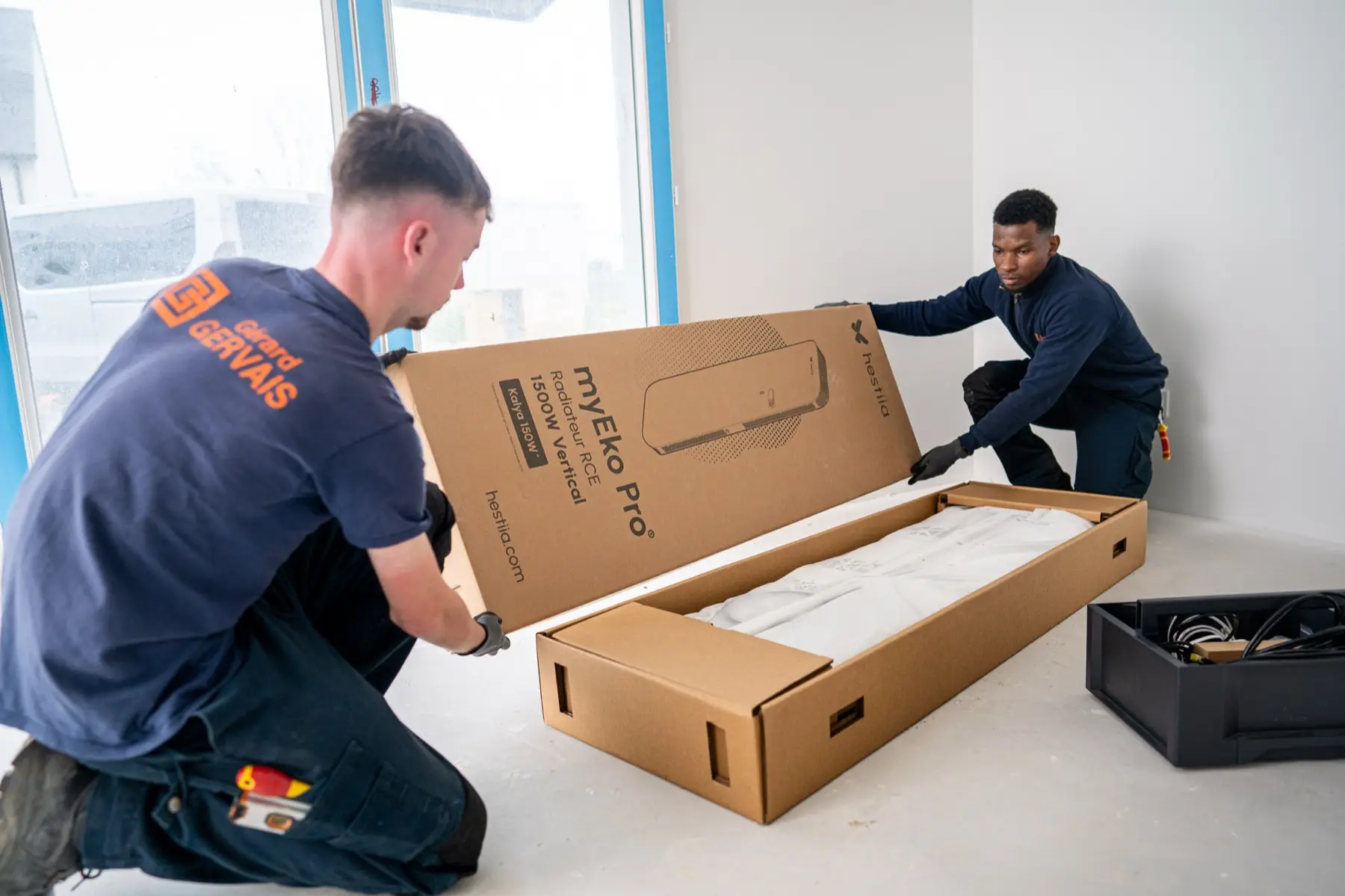
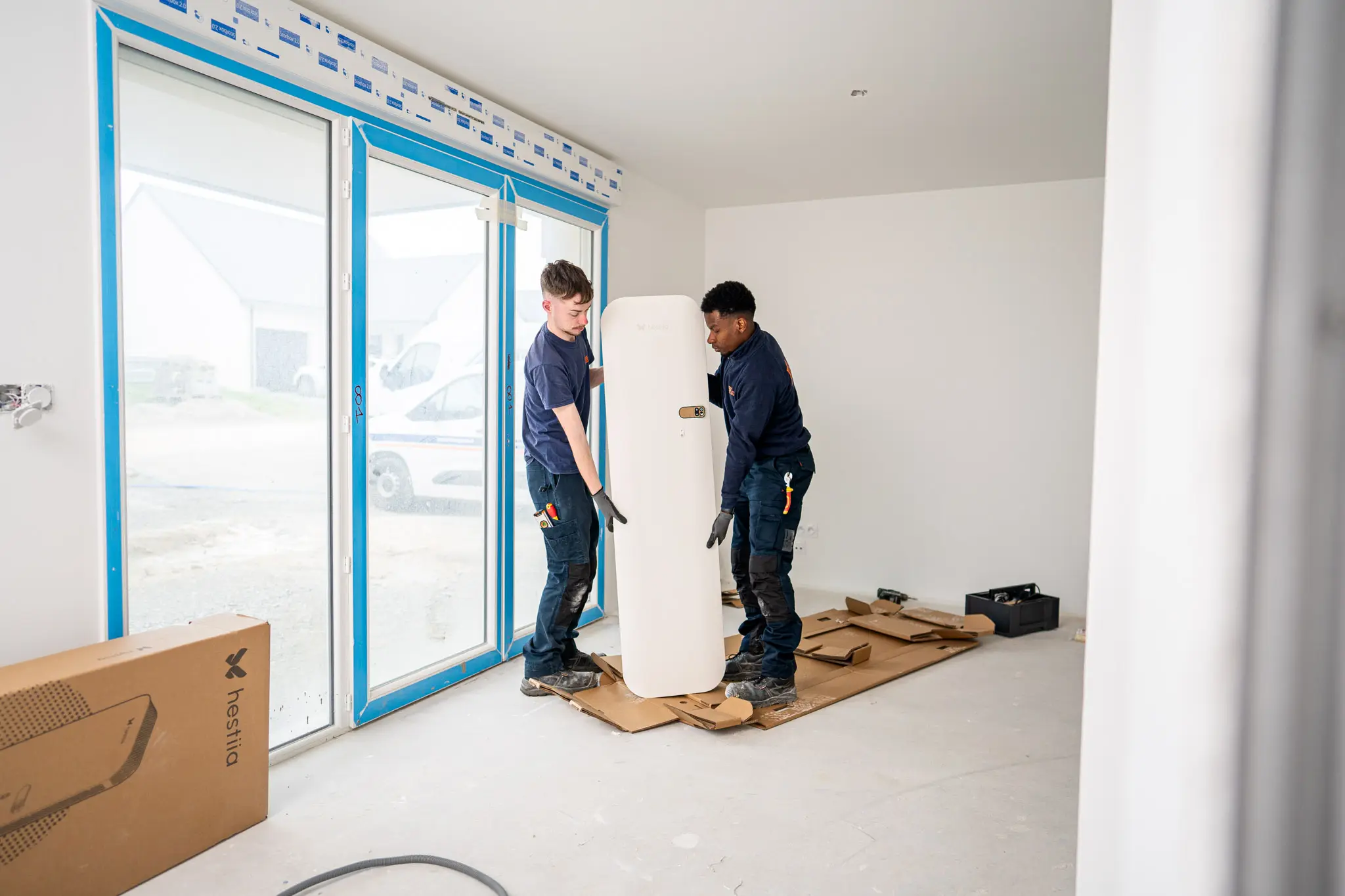
The waste heat recovery radiator (Embedded Waste Heat Recovery) changes the game, precisely because part of its heat does not come from a simple electrical resistance. It is an individual electric radiator that embeds a computing module. This module runs computations and produces heat, heat that is usually lost in data centers, known as waste heat, and which is recovered here to heat the home. This recovered heat has the status of recovery energy. It is what allows the waste heat recovery radiator to meet RE2020’s requirements, where a standard electric radiator falls short.
This is where a common confusion arises: you might think that recovering “already produced” heat means heating more cheaply. That is not the case, and to understand why, you need to distinguish two notions that are often mixed up.
Final energy, primary energy: why the bill doesn’t change
First thing to remember: a waste heat recovery radiator consumes neither more nor less than an equivalent connected electric radiator. It is exactly the same consumption. Recovering heat changes nothing about the electricity you use at home, this is what we call final energy, the energy that appears on your bill. Your bill is therefore the same.
What changes lies elsewhere: in primary energy, that is, the total energy spent at the scale of the whole country. With a waste heat recovery radiator, the same electricity serves two purposes at the same time: heating your home and running computations. Without it, those computations would run in a data center, which would consume electricity of its own, both to run the computations and to dissipate the heat they release. By combining the two, this duplication is avoided.
The benefit is therefore not on your bill, but for everyone: less energy wasted at the national scale and a lighter digital footprint. It is good for society, and for the planet.
For the occupant, the real savings on the bill therefore come from elsewhere: from connected control and, above all, from the quality of the home’s envelope, as stated earlier.
Conclusion
The “toaster” belongs to the past, and above all to a different kind of home. In new builds, energy savings are built first in the envelope: insulation, airtightness, orientation, glazing, inertia. It is the envelope that drastically reduces heating needs. The appliance comes in afterwards, on an already high-performance base, and it is through its intelligence, connected features, consumption tracking, and through the quality of the experience it delivers, that it brings real added value.
Judging an electric radiator on its reputation from forty years ago means missing everything that has changed. The right question is no longer “does electric heating consume too much?”, but “is my home well designed, and does my appliance let me heat comfortably, without wasting?”