Between 2021 and 2023, some social landlords faced increases of up to 140% on their collective gas heating charges.
This episode is largely explained by the volatility of energy prices, but above all it highlighted a deeper reality: choosing a heating system commits the landlord to a cost structure they only partly control, over several decades.
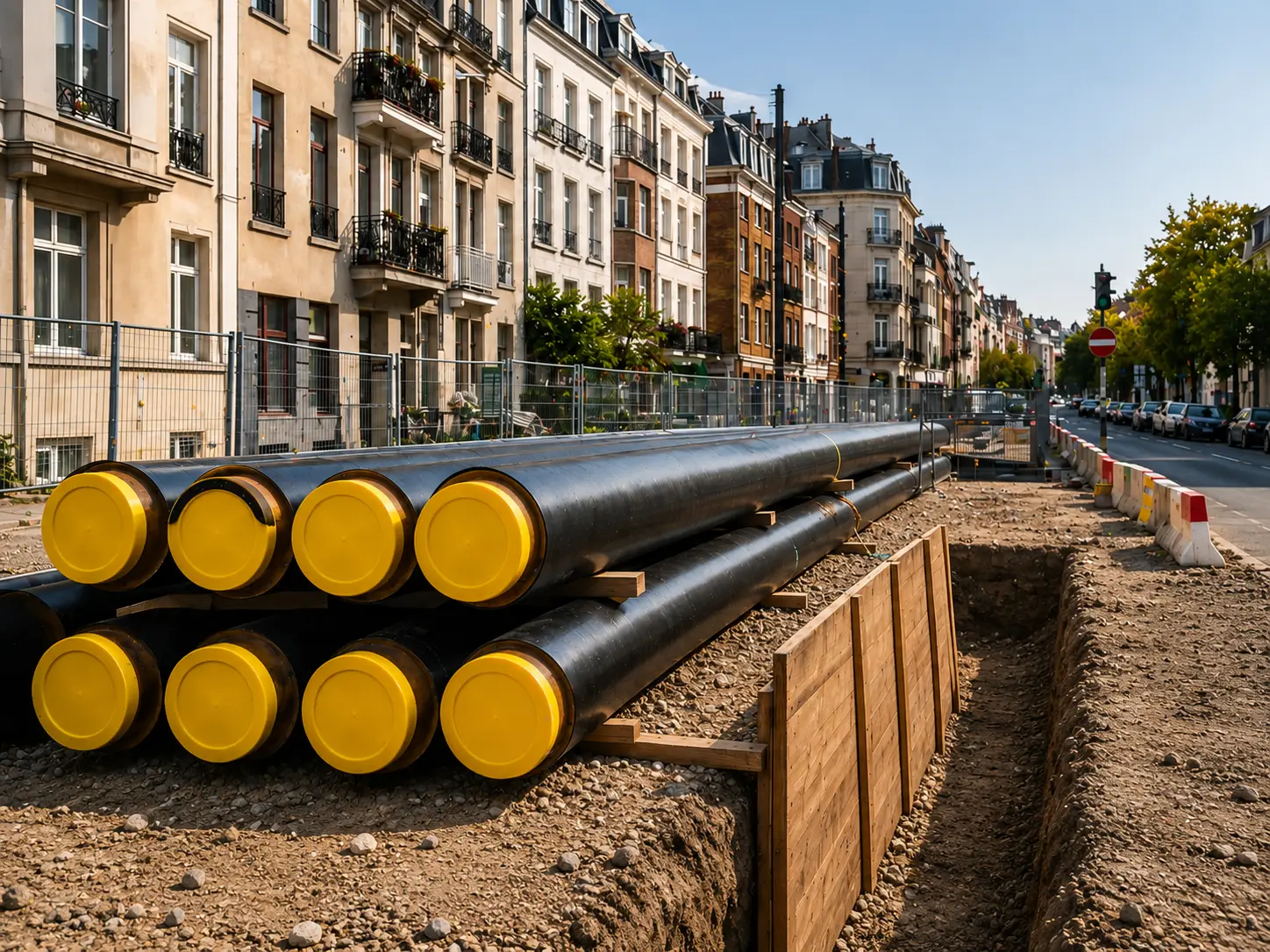
Depending on the solutions chosen, this dependence can be more or less strong: on an energy source, on an operator, on a technical infrastructure or on operating contracts. These parameters, often barely visible at the programme stage, become decisive over time.
At the same time, the RE2020 thresholds are gradually tightening, 650 kgCO₂/m² today, 490 in 2031, and every technical decision made at the programme stage is part of an equation spanning 30 or 50 years.
This guide is intended for social landlords and building owners evaluating their heating choices for new-build collective housing projects. It presents the criteria that really matter over time, the available solutions, and data from real projects.
Why the heating choice commits a social landlord’s finances for decades
In new-build social housing, the cost of a heating system is not limited to its price at delivery. What weighs over time is the TCO, Total Cost of Ownership, that is, all the costs incurred over the building’s life: installation, maintenance, upkeep, breakdowns, future compliance upgrades and charges passed on to tenants.
Collective systems, however, concentrate the risks. A central boiler room or a collective heat pump requires a dedicated plant room, annual maintenance contracts with specialized providers, and interventions whose frequency and cost rise with the age of the installation. These costs are hard to compress, they cannot be passed on through rents already at the ceiling, and they weigh on low-income households.
Technical sobriety is not an aesthetic stance. In social housing, it is a condition of economic viability.
A system that is simpler to install, maintain and understand represents a lower financial risk over the building’s entire lifetime.
The real cost of complexity: breakdowns, misunderstanding, maintenance
In many recent programmes, technical systems have multiplied: dual-flow ventilation, collective heat pump, geothermal probes, heating-cost allocators, management interfaces… Each of these pieces of equipment serves a legitimate goal. Together, they create systems that tenants do not understand and that technical-management teams struggle to maintain.
Disputes related to collective heating mainly concern equipment failures, no heat or insufficient levels, and not consumption. A system that breaks down, even once in winter, generates tensions that last. A system the tenant does not know how to set will never be used optimally, whatever its theoretical performance. And as specialized technicians become scarcer, response times lengthen.
Which system can work correctly in the hands of an ordinary occupant, managed by a technical team with limited human resources?
Good equipment in social housing is often the kind you do not notice: it heats steadily and silently, it lasts over time without repeated intervention, and its settings stay accessible to any occupant.
What is a waste heat recovery radiator and why does it meet RE2020 requirements in collective housing?
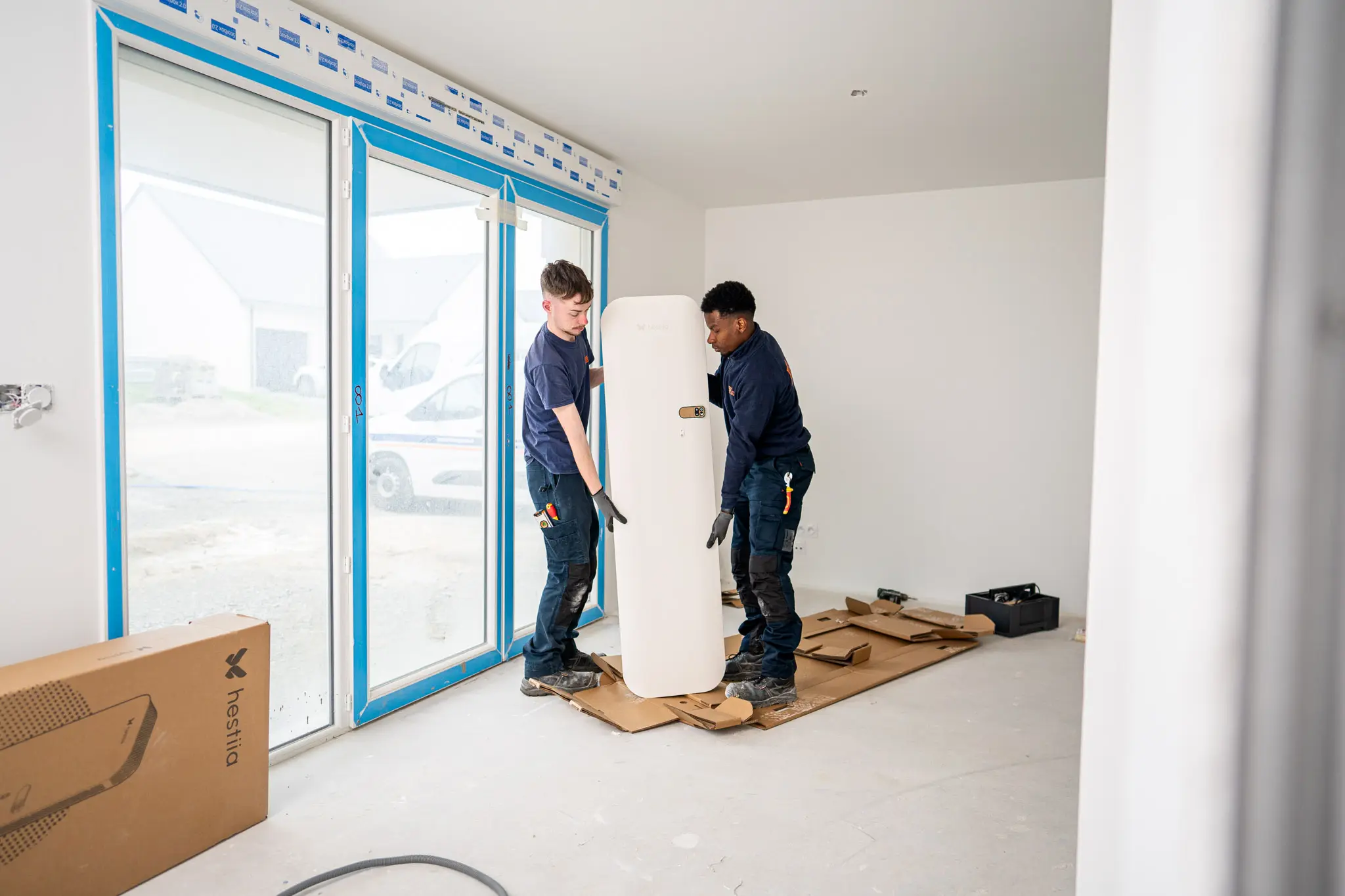
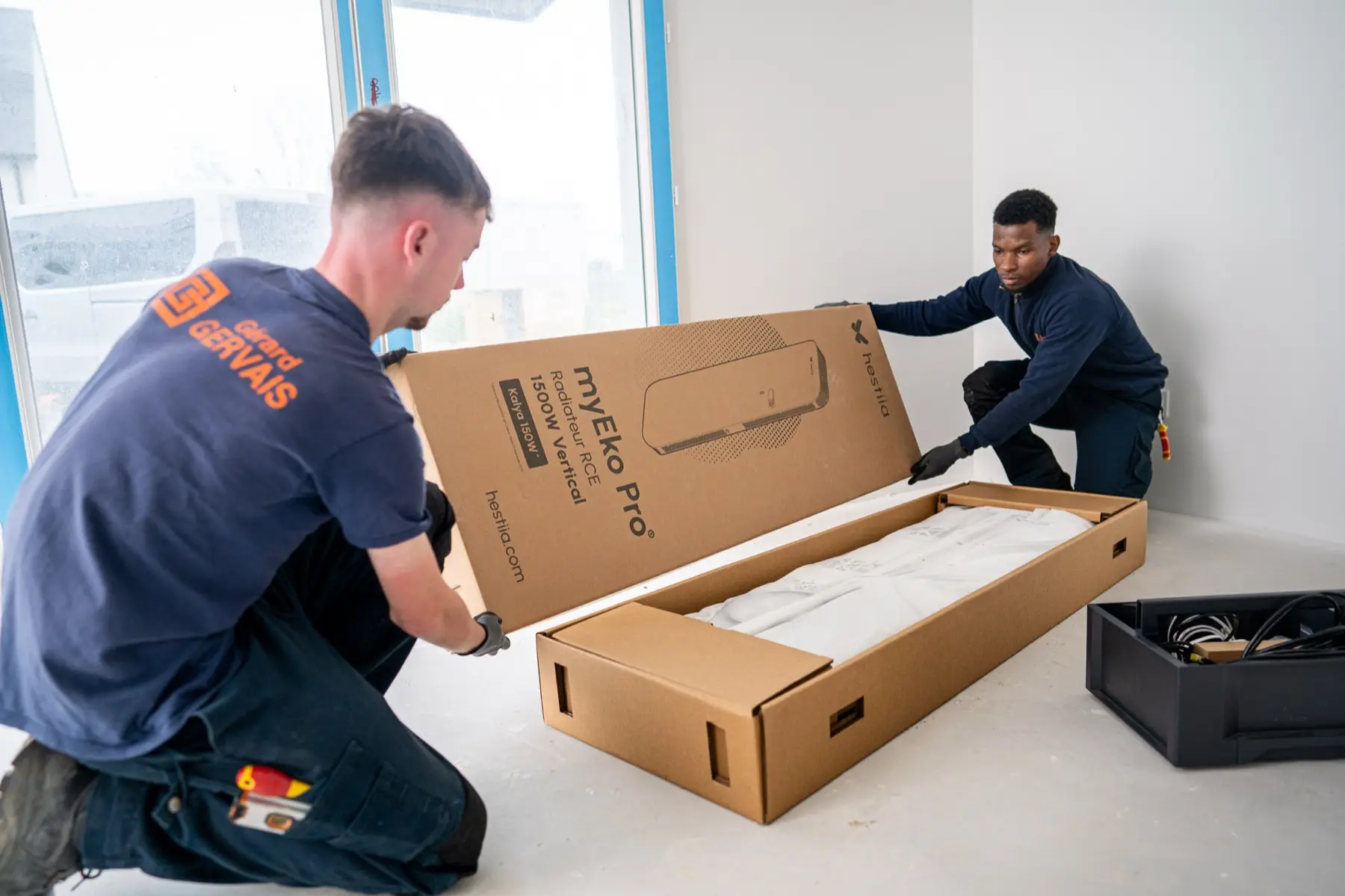
A radiator with Embedded Waste Heat Recovery is an electric radiator that integrates computing modules. These modules perform inference computations for artificial-intelligence models used by digital players. The heat produced by these computations, a waste heat, that is, unavoidable and usually dissipated into the environment, is captured and used to heat the home.
A single electricity consumption. Two simultaneous uses: computing and heating.
From a regulatory standpoint, it is this dual use that changes the indicators. Because the heat put to use comes from recovered energy, it improves the Cep and Cep,nr indicators required by RE2020. Because the product’s design was conceived to reduce its carbon footprint and its installation requires neither plant room, nor hydraulic network, nor substation, the project’s Construction Carbon Impact (IC Construction) is lightened. Waste heat recovery radiators are RE2020-compatible via a Titre V Système, including for the 2028 and 2031 thresholds.
Each radiator works autonomously, room by room, connected to the building’s common-services network. Put end to end, they form a decentralized system with the same purpose as a heat network: to supply useful heat at building scale, without the infrastructure complexity this usually implies.
What the cost data indicates, and its limits
The comparative data available on costs between heating solutions in collective social housing remains limited and heterogeneous.
Studies exist on certain specific systems or devices (heat networks, individualization of heating costs, heat pumps…), but they are rarely comparable with one another, because they rest on different scopes, assumptions and contexts.
To date, there is no public, homogeneous and independent benchmark allowing an exhaustive comparison of the overall cost of the various heating solutions in new-build collective housing.
In this context, the figures presented here come from internal hestiia studies carried out on real projects, and must be interpreted as orders of magnitude dependent on the context studied.
On a project of 37 collective homes, the investment-cost gap between a dual-service heat pump and a waste heat recovery radiators + thermodynamic water heater solution came to +€310,967 for the heat pump, with a payback period estimated at 31 years.
What is structural, however, regardless of the project: decentralized systems remove the cost items linked to central equipment, plant room, hydraulic network, collective maintenance contracts.
Comparative table of heating solutions
| Solution | Strengths | Points to watch | Investment cost | Operating cost |
|---|---|---|---|---|
| Dual-service collective heat pump | High energy performance, sometimes more relevant for a renovation than for a new-build home where insulation, the no. 1 factor of thermal comfort, has been optimized. | Mandatory plant room, heavy maintenance, increasingly scarce specialized technicians | High | High |
| Urban heat network | Pooling, renewable & recovered energy possible | Dependence on the operator, costs varying by contract | High | Variable |
| Hybrid gas heat pump | Energy flexibility | Gas banned in new-builds from 2028, dual maintenance | Medium to high | Medium to high |
| Standard electric radiators | Simplicity, low investment | Does not meet the RE2020 environmental regulation | Low | Medium |
| Waste heat recovery radiators | Usable within RE2020, no heavy maintenance | Recent technology, long-term feedback in progress | Medium | Low to medium |
Two projects, two contexts, the same operational findings
Case study
Maine-et-Loire Habitat, Tiercé (49)
Maine-et-Loire Habitat chose waste heat recovery radiators for a social residence with tight budget constraints, in a configuration where standard electric radiators could not meet the RE2020 thresholds. The technical-management team highlighted ease of operation as a concrete day-to-day advantage.
Case study
Les Nouveaux Constructeurs, Colomiers (31)
On this project, the waste heat recovery radiators were compared with a collective hybrid heat pump. The absence of a plant room made it possible to recover square metres redistributed as shared spaces. On the tenant side, individual room-by-room control was identified as a valued comfort factor.
Conclusion
The RE2020 thresholds evolve through to 2031 towards near carbon-neutral buildings across their entire life cycle. The technical choices made today at the programme stage are therefore not only immediate-performance decisions: they also determine the financial, operational and environmental sustainability of the housing stock over several decades.
Waste heat recovery radiators are an option worth evaluating seriously for landlords seeking to reconcile environmental performance, ease of operation and control of rental charges, particularly on programmes where a complex collective system would be oversized or hard to maintain. As with any heating solution, their relevance must be assessed case by case, based on the project’s constraints, the landlord’s objectives and the results expected over the long term.