An urban heat network starts from heat produced somewhere and carries it to homes. The waste heat recovery radiator does the opposite: it brings heat production directly into the homes. Same purpose, reversed architecture, and a double benefit, regulatory at the building scale, environmental at the scale of digital infrastructure.
What is an urban heat network?
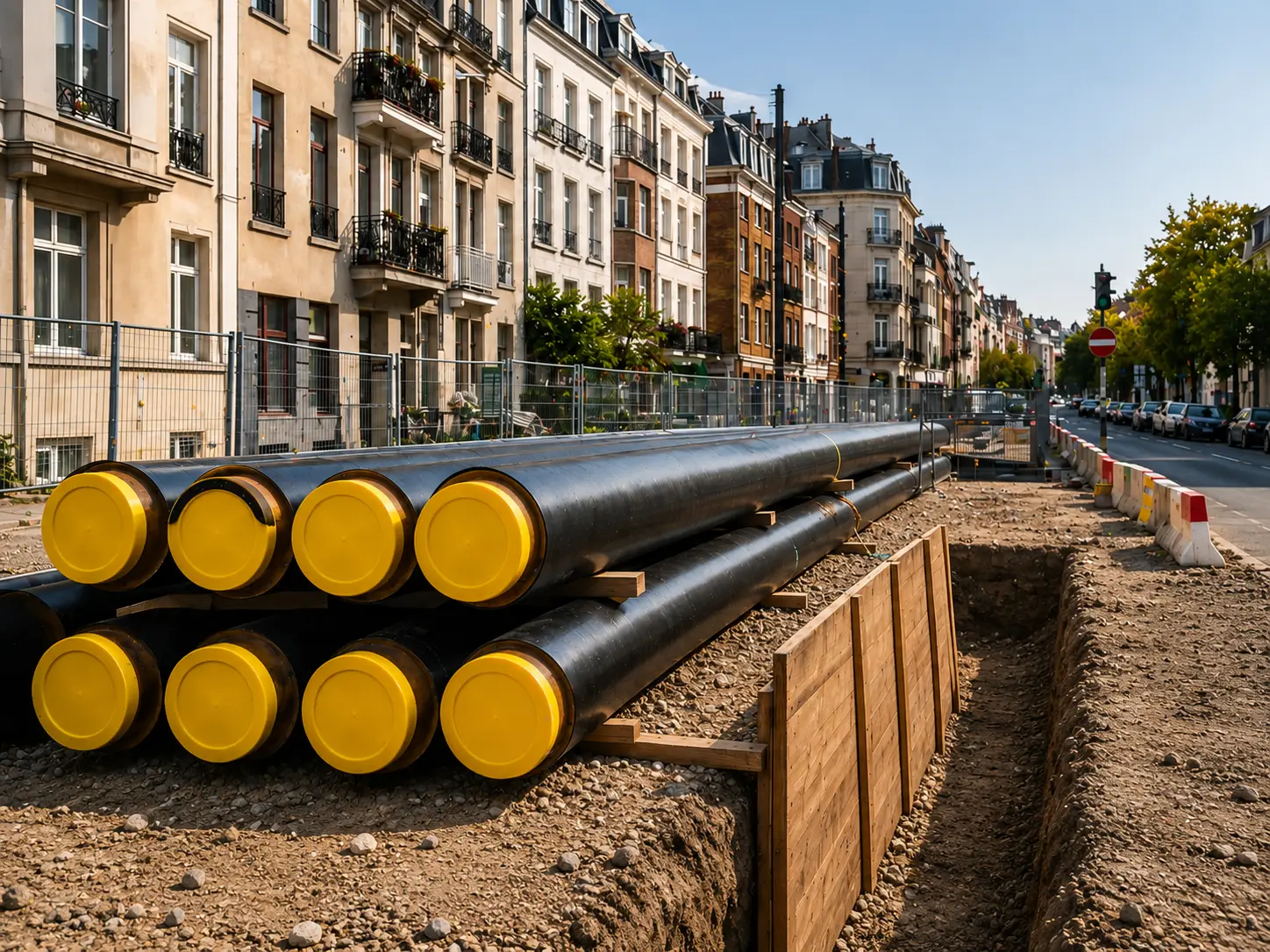
An urban heat network is a collective system that heats several buildings from a centralized source. The heat is produced in a dedicated facility (biomass boiler, incinerator, geothermal energy), then transported through underground pipes to the connected buildings, where it supplies heating and domestic hot water.
What makes it structurally valuable: this heat is often waste heat. It is produced anyway, by an incinerator or an industrial process, and the network simply captures and conveys it rather than letting it dissipate. France today has more than 1,000 networks of this kind, delivering 32.3 TWh per year, of which 67% from renewable or recovered sources, compared with 31% in 2009 (source: annual FEDENE/CEREMA survey, 2025).
For the occupant, how it works is opaque, and that is by design. The heat arrives. They pay their subscription and their consumption. The production is invisible to them.
The waste heat recovery radiator: same principle, reversed direction
In a heat network, the heat travels. It starts from a central point, crosses pipes, and arrives in the homes. For this to work, you need heavy infrastructure: civil engineering, delivery substations, a plant room in each connected building. Cerema estimates the average cost of a heat-network project at around €2 million.
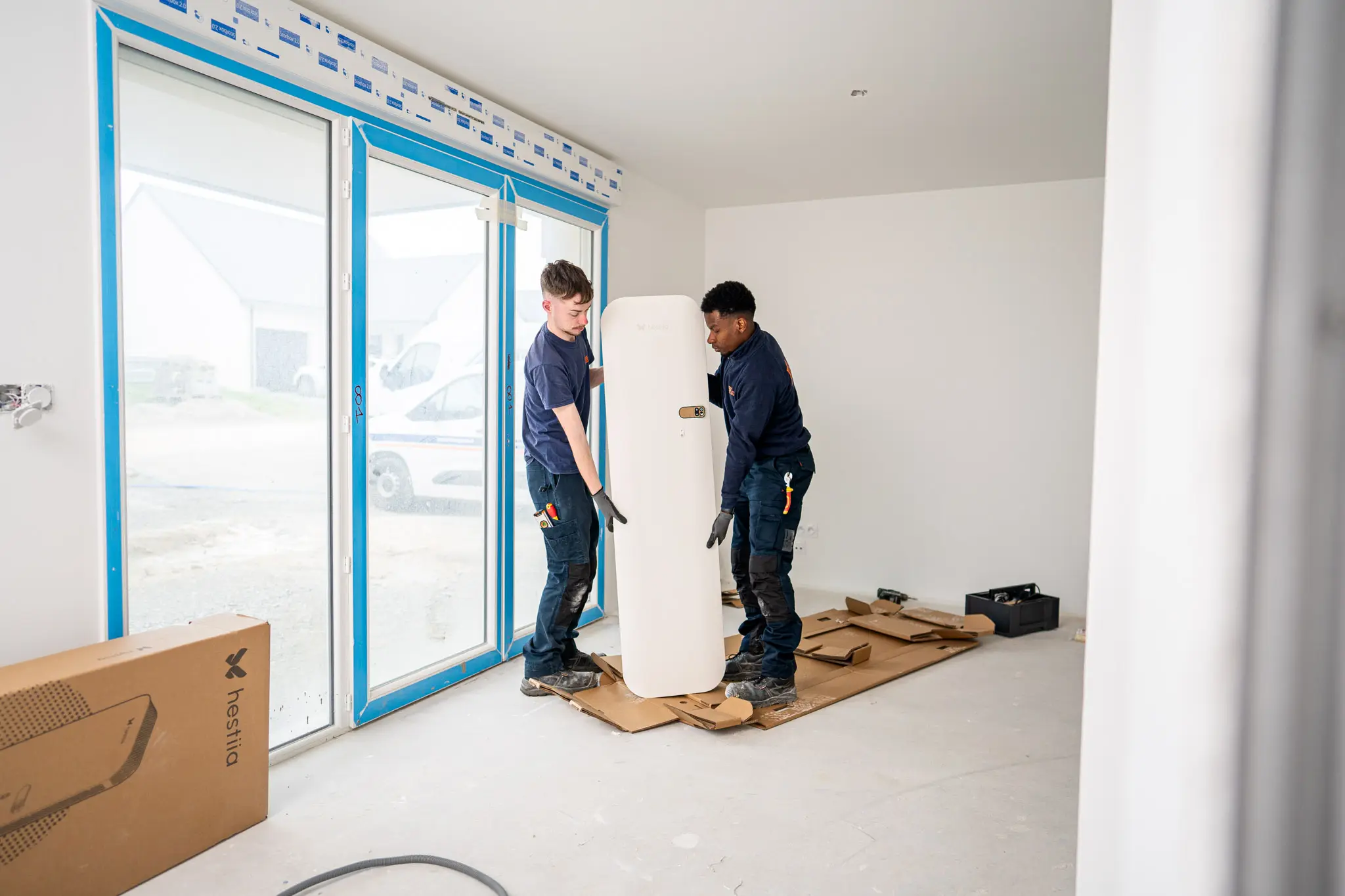
It is not the heat that travels to the home, it is the heat source that is installed in the home.
This is the principle of hestiia®‘s myEko Pro® waste heat recovery radiators. Inside the radiator, computing components carry out inference computations for artificial-intelligence models. These computations generate heat, a waste heat, unavoidable, identical to the heat dissipated by standard data centers, simply lost in their cooling systems. Here, it is captured and used directly to heat the room.
From the occupant’s point of view, nothing changes: it is a connected electric radiator, like any other. They plug it in, set the temperature from their app, they are warm. Their electricity bill reflects their consumption, exactly as for any electric heating device. The computing running inside asks nothing of them, changes nothing in their use, and does not alter by a single cent what they pay. For them, it is a radiator, full stop.
From the building’s point of view, each radiator becomes a node of local production. Put end to end across the homes, they form a distributed system that covers the same needs as a heat network, without pipes, without a substation, without a plant room.
What concretely changes for a developer or a landlord
| Aspect | Urban heat network | Waste heat recovery radiator |
|---|---|---|
| Heat source | Centralized (boiler, incineration, geothermal…) | Embedded in each radiator (computing) |
| Infrastructure | Underground pipe network, substations | Connection to the common-services electrical network |
| Deployment scale | Several buildings from a central point | Room by room, home by home |
| Works | Heavy civil engineering, dedicated plant room | Installation identical to a standard radiator |
| Geographic coverage | Limited to already-served areas | No geographic constraint |
The result is identical, homes heated from energy put to use. What changes is the complexity of implementation, the level of dependence on a third-party infrastructure and the granularity of deployment.
What it changes from a regulatory standpoint (RE2020)
The waste heat recovery radiator acts on several RE2020 indicators at once. Since the heat it gives back is recovered heat, it is not counted in the Cep and Cep,nr (total and non-renewable primary energy consumption), which lightens them. Its electricity, from a low-carbon French mix, works in favour of the energy carbon impact. And its sober design limits the construction carbon impact.
This combination makes it relevant up to the 2028 and 2031 thresholds, where a standard electric radiator does not pass.
The real gain from computing is not individual, it is collective
The occupant enjoys efficient heating, the building improves its RE2020 score. But the value of the computing plays out at the collective scale, not the individual one.
The rise of AI is causing computing needs to explode. According to the International Energy Agency (Energy and AI report, April 2025), data centers’ electricity consumption is expected to rise from 485 TWh in 2025 to 945 TWh in 2030, nearly double. For AI-dedicated centers alone, it could triple.
Yet in a standard data center, nearly 40% of the electricity is not used to compute: it is used to cool (source: ADEME, 2024), that is, to remove the heat the machines produce, heat released into the atmosphere, lost. Energy is spent running the computations, then energy is spent destroying the heat from those computations.
The waste heat recovery radiator removes both of these losses. The heat from computing is no longer a waste to be removed: it is the useful product. No cooling system to power, no heat wasted. The same electron serves twice, for computing, then for heating.
This is why the benefit is read not at the scale of a home, but at that of the entire digital infrastructure: distributing computing across radiators rather than concentrating it in centers that must be cooled reduces the footprint of every hour of computing. An advantage that benefits everyone, well beyond the building that hosts the radiators.