What is waste heat?
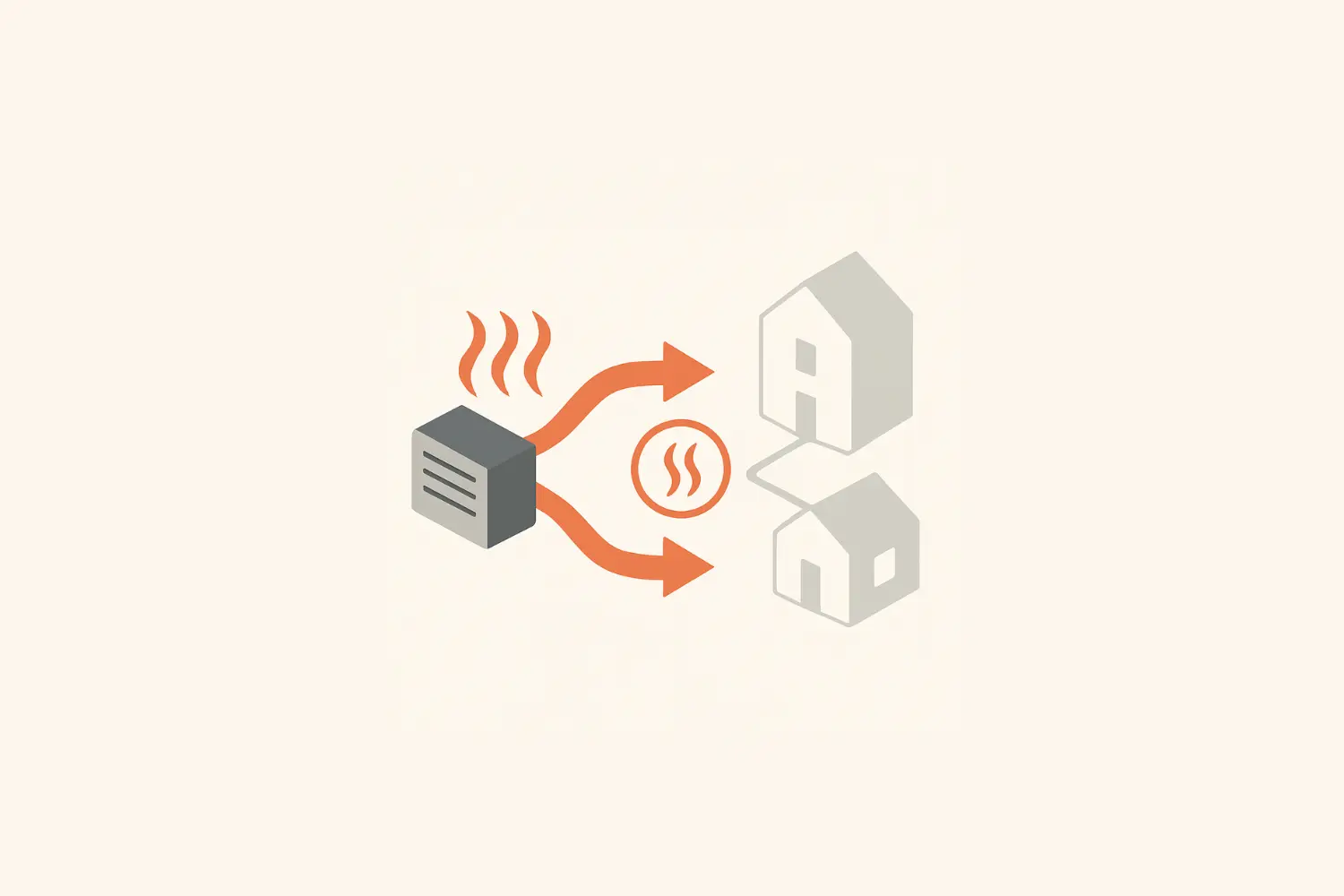
Waste heat — sometimes referred to as “lost heat” — is the thermal energy inevitably generated during industrial or technical processes that is not put to any further use.
In other words, it is heat produced by a system whose primary function is not to generate heat.
This heat can either dissipate into the surrounding environment, or be artificially cooled when conditions do not allow natural dissipation or when temperatures are too high.
Where does waste heat occur?
Waste heat is observed across a wide range of industrial processes, as well as in certain commercial and office equipment.
Among the most notable examples:
- Cooling processes that actually reject heat (simply place your hand behind a refrigerator to see this firsthand)
- Municipal waste incineration
- Greywater discharge (from showers, washing machines, and dishwashers)
- Heating equipment itself — both industrial and domestic (ovens, boilers, etc.) does not produce only “useful” heat: consider, for instance, the heat contained in exhaust flue gases or in the unit’s casing
- IT processes: this is easy to verify by touching a laptop after two or three hours of continuous use
The emblematic case of data centres
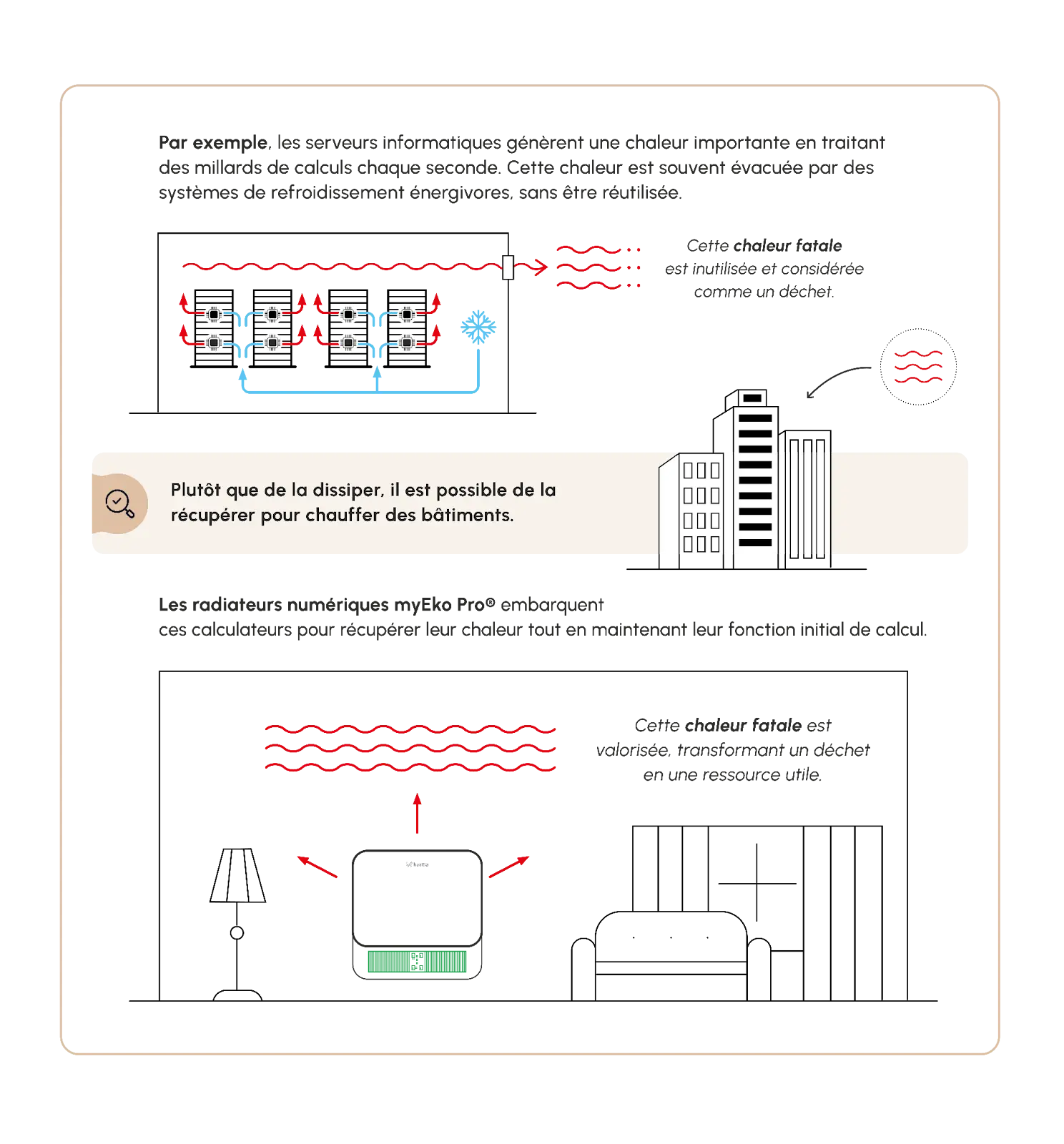
Computer servers generate substantial heat because they must process billions of calculations every second.
This heat is rarely reused and must typically be removed by energy-intensive cooling systems. Rather than wasting it, this heat can be recovered to heat buildings.
The rapid growth in computing demand — driven in particular by artificial intelligence — makes this a priority sector for curbing the energy footprint of digital technology.
In 2023, ADEME estimated that the 264 data centres located in France generate 8.5 TWh of waste heat — equivalent to the output of more than one nuclear reactor.
Waste heat is not a lost cause — it can be recovered
Waste heat represents a significant energy resource that can be harnessed rather than discarded. ADEME estimates it accounts for over 10% of France’s total energy consumption.
Waste heat recovery involves capturing those calories and channelling them toward another application that requires thermal energy. The most common uses include building heating, hot water production, or injection into a district heating network.
Harnessing it reduces the amount of primary energy needed for the intended secondary use.
Depending on the form in which waste heat is generated (steam, flue gas, hot water, etc.), a conversion step may be necessary to transform it into usable energy. For example, it can be used to generate electricity.
What is recovered waste heat used for?
There are three main destinations for waste heat:
- It can be consumed directly on-site. For example, if office space is adjacent to a factory, the heat can be recovered to warm the office areas.
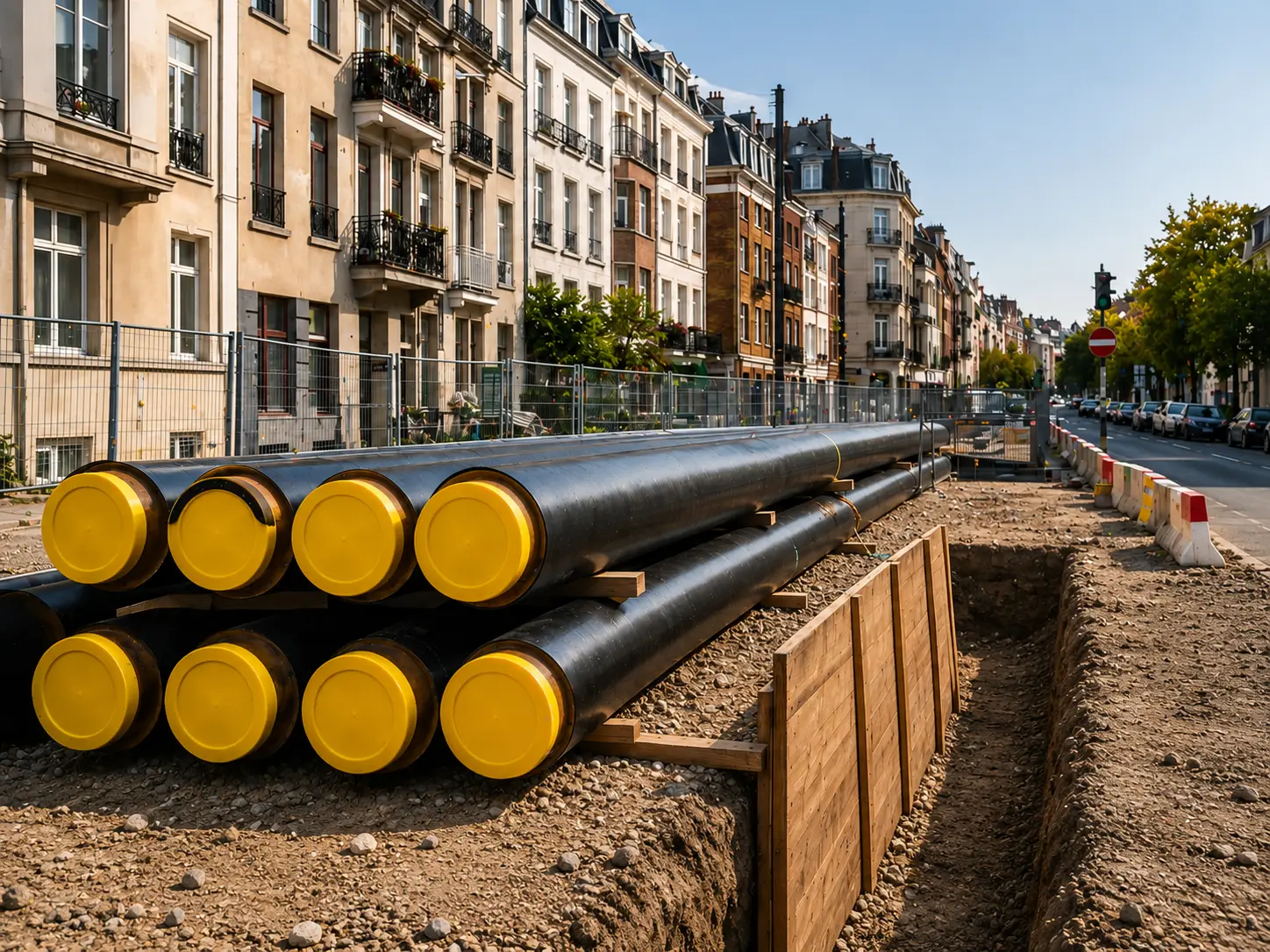
- It can be fed into a district heating network, contributing to heating a swimming pool, a gymnasium, public buildings, and more.
- It can be harnessed in a decentralised manner, integrated directly into individual heating equipment such as hestiia’s myEko Pro® hybrid heaters. This heat is recovered locally to warm homes without requiring heavy infrastructure.
What are the benefits of waste heat recovery?
Waste heat recovery delivers multiple benefits for all stakeholders:
For the business investing in the recovery process:
- Cost reduction and competitiveness: by recovering their unused heat, businesses with computing needs reduce their cooling costs. At the same time, the heating generated from this reused energy eliminates the need to deploy additional heating units and purchase the equivalent amount of primary energy. This dual optimisation helps limit energy expenditure and improve competitiveness.
For society:
-
Contribution to the national energy efficiency plan aimed at preserving grid stability and achieving carbon neutrality by 2050. By harnessing waste heat, we reduce primary energy demand and limit the need for additional energy production.
-
Lower greenhouse gas emissions: by replacing fossil fuels and by avoiding the manufacture and operation of additional heating equipment. This contributes directly to the fight against climate change.
-
Contribution to energy independence, since waste heat is by definition a local energy source.
myEko Pro® — a practical application of waste heat
The myEko Pro® smart heaters equipped with the Embedded Waste Heat Recovery (RCE) module incorporate computing units that naturally generate heat — much like a computer in operation. But instead of dissipating it uselessly, this heat is used directly to warm the home, with zero waste.
This is a highly practical and straightforward example of waste heat recovery in a residential setting, optimising energy that has already been produced rather than consuming more.
A recognised renewable energy source
myEko Pro® heaters reduce national energy consumption by using a single energy source to simultaneously perform computing and provide domestic heating — where traditionally, data centres and heaters consume energy separately.
The savings are all the more significant given that data centres consume roughly 40% additional energy just to cool their servers. By performing those computations inside myEko Pro® units, the electricity previously used for data centre cooling is eliminated entirely, enabling a reduction in primary energy consumption and the decarbonisation of housing stock at a national scale.
The waste heat recovered by myEko Pro® is a renewable energy source.
This is why myEko Pro® is currently the only electric heater that facilitates RE2020 compliance across the key indicators: CEP, CEP nR, IC Energy, and IC Construction.