What Are the Key Principles of RE2020 and How Do They Affect Heating?
RE2020 is a set of technical regulations for new construction in France, aimed at reducing the environmental impact of buildings. It addresses three main areas:
- Managing energy demand, notably through high-performance thermal insulation
- Reducing greenhouse gas emissions throughout the entire lifecycle, including construction, as part of a “lifecycle analysis”
- Accounting for “summer comfort” (maintaining acceptable temperatures during heatwaves)
These requirements, calculated using indicators for energy efficiency and carbon impact, have significant implications for heating system selection, steering choices toward renewable sources and low-carbon systems.
What Criteria Determine Heating Choices Under RE2020?
The primary consequence of these objectives: the defined carbon dioxide emission thresholds are extremely low. This effectively rules out gas and oil heating. Only high-performance gas solutions hybridized with renewable energy or electricity can hope to meet the new thresholds.
At the same time, electricity has been revalued. Despite being a low-carbon energy source in France, electricity previously suffered from an unfavorable conversion coefficient. It was assumed that 2.58 kWh of primary energy were needed to produce 1 kWh of final electrical energy. This coefficient has been lowered to 2.3. Likewise, the carbon index for electricity has been significantly revised downward: from 210 g CO2/kWh to just 79 g. Electricity is therefore the clear winner of the coefficient revision.
More specifically, RE2020 evaluates new construction against numerous indicators, the six most important being:
-
CEP: This indicator reflects primary energy consumption expressed in kWh/m²/year, combining the energy needed for heating, cooling, lighting, domestic hot water production, and auxiliary systems.
-
CEP nR (non-renewable primary energy consumption): For the same uses as CEP, it totals the energy derived from non-renewable sources. This indicator is new in RE2020. Meeting the targets requires satisfying both CEP and CEP nR thresholds.
-
Bbio (bioclimatic needs): This index reflects the building’s energy efficiency by assessing heating, cooling, and lighting requirements.
-
IC énergie: This quantifies the carbon impact of energy consumption during the building’s operational life (expressed in kg CO2/m²). For multi-unit residential buildings, it must now be below 6.5.
-
IC construction: This aggregates the carbon emissions associated with building components and generated during the construction phase.
-
DH (degree-hours of discomfort): A new index for this regulation that evaluates the building’s ability to remain livable during extreme heat (the gap between indoor temperature and the target comfort temperature).
Which Heating Systems Are Compatible with RE2020?
Four types of heating systems stand out for their ability to meet RE2020 criteria.
1. Heat Pumps (Air-to-Air, Air-to-Water, Geothermal)
A heat pump captures calories from the air or ground and then feeds the heating system via a heat-transfer fluid. In some configurations, it can also provide domestic hot water or air conditioning.
Powered by electricity, its key advantage is generating four times more energy than it consumes. In most configurations, it meets RE2020 requirements.
In the public imagination, heat pumps are closely associated with single-family homes. Yet they can also be used in multi-unit residential buildings, with two options:
- An individual heat pump installed in each dwelling
- A collective heat pump serving the entire building
The choice between these two options depends on:
- The size of the building (individual heat pumps are generally better suited to smaller buildings)
- Available space (a utility room for the indoor unit, a rooftop terrace or courtyard for the outdoor unit)
- Urban planning and neighborhood constraints, particularly regarding noise
2. Condensing Boilers
Installing gas heating is possible under very specific conditions: only a very high energy efficiency condensing boiler, coupled with a renewable source (such as a heat pump), can achieve RE2020 thresholds.
This system is known as a “collective hybrid heat pump.” The concept is that the heat pump operates at maximum capacity, while the boiler provides supplementary heating during peak demand periods — for example, when outdoor temperatures are extremely cold.
3. Biomass Boilers
All biomass equipment (pellets, logs, wood chips, etc.) is valued under RE2020, since wood is considered a renewable resource, provided the equipment carries the Flamme Verte 7 certification.
Collective biomass heating requires available space (both for the boiler and for fuel storage), which can be a drawback in the most space-constrained buildings. On the other hand, the cost of wood currently makes it a competitive energy source.
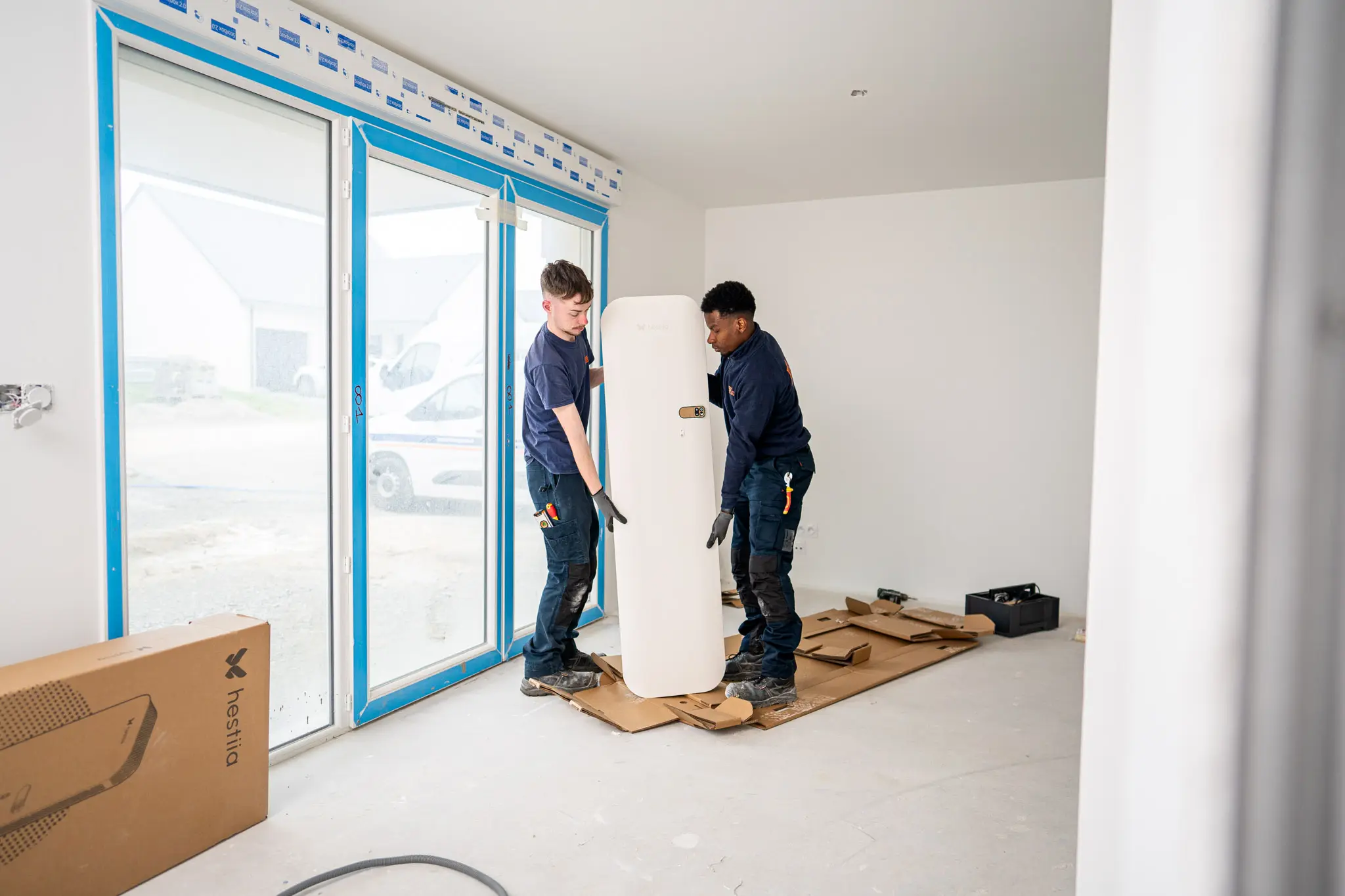
4. Digital Electric Heating
Digital electric heating is an innovative and rapidly growing solution, highly promising for addressing energy, environmental, and economic challenges.
This heating method relies on two components: a resistive element, similar to a conventional electric heater, and a computing element, which generates heat through computational processes performed directly within the heaters.
Rather than allowing this heat from the computing units to go to waste, digital heating recovers it and uses it to heat the dwelling. This makes it possible to reduce primary energy consumption and optimize energy efficiency.
Thanks to this approach, digital electric heating meets RE2020 thresholds in all configurations.
Beyond its environmental benefits, digital electric heating offers numerous advantages:
- Purchase cost: Its initial cost is moderate compared to other RE2020-compliant heating systems, making it an accessible solution for new-build projects.
- Installation: It operates on a standard electrical supply, requires no utility room or hydraulic connections, which simplifies implementation and reduces construction costs.
- Operation: It requires zero maintenance, limiting operating costs over the long term.
- Thermal comfort: It delivers consistent, responsive heat while adapting to occupants’ needs through its connected features.
Choosing a heating system for a new building is no longer just a matter of thermal comfort. It must meet strict requirements for energy performance and environmental impact while remaining economically viable.
Each project must be evaluated on a case-by-case basis, taking into account technical constraints, budget, and environmental objectives.
But one thing is certain: regulations are evolving, and heating solutions must be designed today to meet tomorrow’s standards.
If you would like to explore your next project with our solution, get in touch now.