What are the main features of RE2020? What environmental objectives underpin it?
RE2020 (Réglementation Environnementale 2020) is France’s Environmental Regulation for new buildings, in effect since 2022. Its overarching goal is to consider the entire lifecycle of buildings — design, construction, and operation — through the lens of environmental performance.
More specifically, RE2020 requires builders to:
- Prioritize lower-carbon energy sources and the most efficient technologies
- Calculate and reduce the overall carbon impact
- Select higher-performing heating and insulation solutions
- Better account for “summer comfort” — i.e. occupant wellbeing during extreme heat events
- Encourage on-site energy self-consumption
The previous regulation, RT2012, focused solely on final energy consumption, whereas RE2020 takes into account primary energy and associated CO2 emissions, starting from the construction phase itself.
Which buildings are subject to RE2020? What are the key implementation dates?
RE2020 applies only to new buildings.
Existing buildings, renovations, and structures that do not require a building permit or prior declaration fall outside the scope of these rules.
Only mainland France is covered by RE2020; overseas territories are not subject to this regulation.
The deadlines vary depending on building use. The new rules came into effect:
- January 1, 2022 for residential buildings (single-family homes and multi-unit housing)
- July 1, 2022 for offices and educational buildings
- January 1, 2023 for residential building extensions and “light leisure dwellings” (e.g. holiday bungalows)
and therefore now apply to all new projects.
What are the requirements and evaluation criteria of RE2020?
The regulatory requirements cover:
- Manufacturing of building components
- Construction and earthwork
- Building operation and maintenance
- Deconstruction or demolition
over a conventional operating period of 50 years.
They do not, however, apply to:
- Pre-construction demolition and any site decontamination
- Transportation of construction workers and building occupants outside the premises
- Furniture
All surfaces included in the building permit (building and plot) are factored into construction indicators and into assessments of energy and water usage.
RE2020 therefore defines minimum performance criteria for:
- Energy consumption related to heating, cooling, lighting, domestic hot water production, and auxiliary systems (pumps and fans, including those in common areas and car parks, as well as occupant mobility via elevators and escalators)
- The building’s “lifecycle,” evaluated through a lifecycle assessment (LCA) with environmental indicators. These indicators cover, among other things, the extraction of raw materials for construction products and their transportation, end-of-life demolition requirements, and the resulting waste treatment
Key indicators to keep in mind:
- A new criterion called “climate change impact” (IC), measured in kgCO2eq/m². It captures the lifecycle assessment for both the “construction” and “operation” phases
- A criterion already used in RT2012 and in the EPC (Energy Performance Certificate), but now strengthened: the CEP (primary energy coefficient), measured in kWhpe/(m².yr), which evaluates energy requirements. For the first time, it accounts for the origin of the energy (renewable vs. non-renewable) to incentivize reducing consumption from non-renewable sources first
The thresholds that must not be exceeded vary according to building type (offices, housing, etc.) and external constraints (e.g. geographic zone). They are progressively tightened to allow the entire industry to adapt: for example, different thresholds apply for construction between 2022 and 2024, then between 2025 and 2027, and so on.
Does RE2020 replace RT2012?
RE2020 does indeed replace the RT2012 thermal regulation for new buildings from 2022 onward (or 2023 depending on building type).
RT2012 focused on the following objectives:
- Ensuring only buildings with controlled, moderate energy consumption are built
- Accounting for summer comfort for the first time
- Encouraging renewable energy production
RE2020 raises the bar on the performance level expected for each of these 3 objectives. To give an order of magnitude, the energy requirements of an RE2020 building must be approximately 30% lower than the regulatory thresholds set by RT2012.
Above all, it introduces the inclusion of the upstream phase — the construction stage — in the building’s carbon impact calculation.
What are the consequences of RE2020 for building owners and engineering firms?
The entire construction chain is affected by these new regulations.
Engineering firms and architects are on the front line, integrating these new rules into building design and, in particular, calculating the expected carbon footprint of the construction phase in advance. They are also required to develop stronger expertise in bioclimatic design, as this carries greater weight in building evaluation and compliance.
Building owners are also involved in carbon footprint calculations — for construction, for building operation, and for its eventual end of life.
As for building managers (property companies, housing providers, etc.), they must enter actual consumption data retroactively on the OPERAT platform.
From a very practical standpoint, four key shifts will have downstream impacts across the entire building industry:
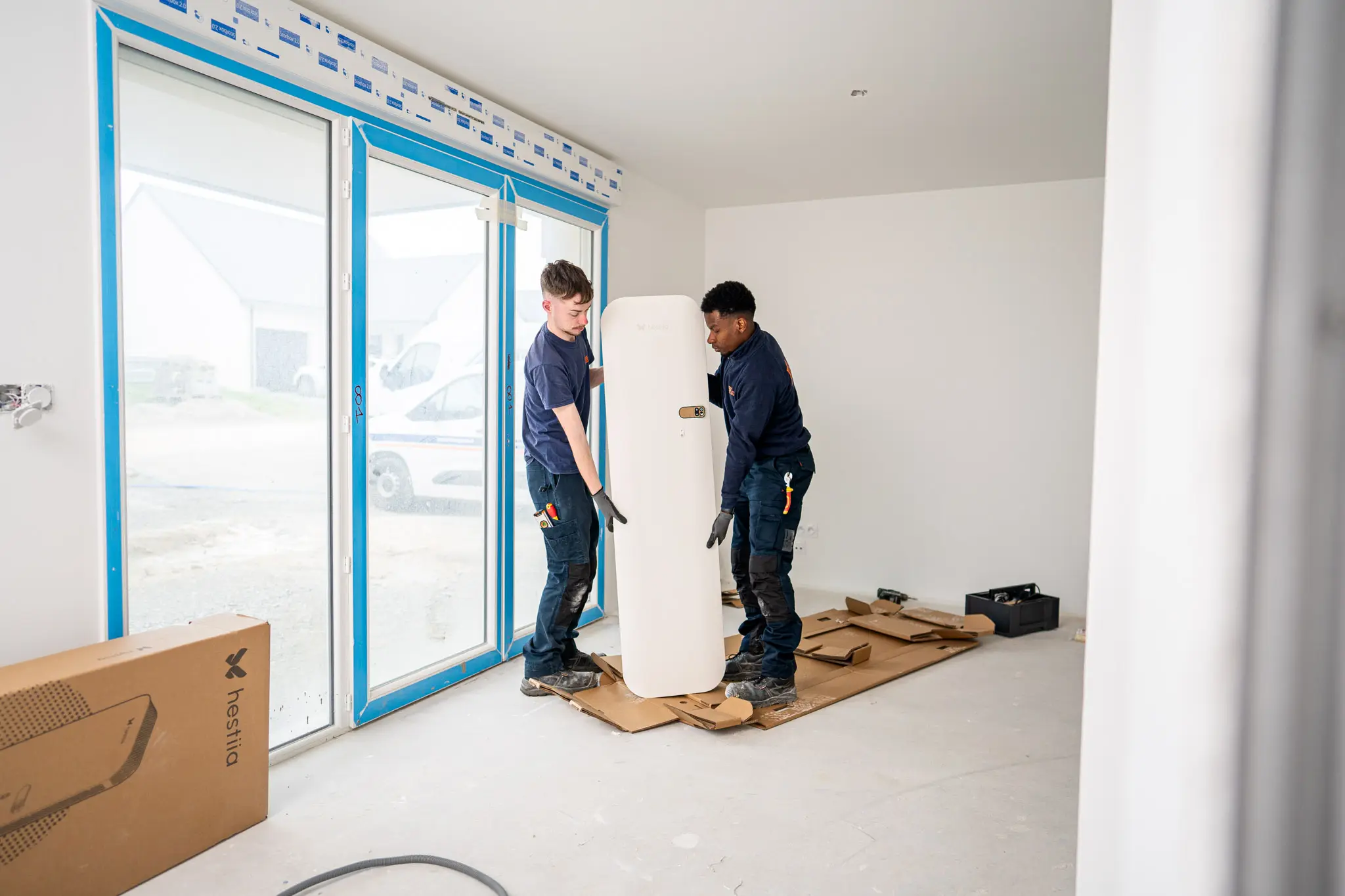
- The announced end of gas as a primary heating source: in favor of heat pumps, wood heating, and high-performance electric heating
- The growing importance of bio-sourced and geo-sourced materials, due to their low carbon footprint
- The reinforced role of wood in construction and heating energy, with updated conversion coefficients
- The acceleration of solar panel and thermodynamic hot water tank installations, in view of net-zero or positive energy balance objectives
RE2020 also introduces new mandatory post-construction inspections, including ventilation system checks, to verify that the expected environmental performance is actually achieved.
What are the next steps for RE2020?
Performance requirements are being progressively tightened over the years.
Key dates to note: in 2028 and 2031, new maximum carbon emission thresholds will come into effect. For the various stakeholders in the building industry, this means the need to anticipate upcoming deadlines — and in particular, to seek out technical solutions now that will meet future requirements.
This is one of hestiia®‘s core missions: to work with you and for you on the heating of tomorrow, helping you meet your regulatory obligations while also providing occupants with optimal comfort and reduced energy costs.