Thermostats: What Are We Talking About?
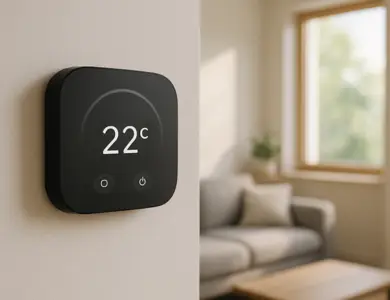
A thermostat is a heating control device that manages the target temperature in a dwelling based on daily schedules, planned absences, occupants’ needs, and more.
Three types of thermostats can be distinguished:
- Standard thermostat: You program the desired schedules and temperatures directly on the device itself.
- Connected thermostat: In addition to standard features, you can control the heating remotely and in real time via a mobile app.
- Smart thermostat: Beyond connected features, it detects occupant presence or absence, outdoor temperature, open windows, and more.
Thermostats are compatible with various heating systems (gas boilers, heat pumps, electric underfloor heating, electric radiators).
Proven Savings Potential from Installing a Thermostat
All studies agree: acquiring a programmable thermostat, or a programmable connected radiator, is an effective lever for energy savings. Estimates from ADEME (France’s energy transition agency) show average savings of 15% following the installation of temperature programming in a dwelling.
To understand the significance of this feature, consider that heating accounts for 60% to 75% of a French household’s annual energy expenditure. Fine-grained temperature control in a dwelling, hour by hour, is therefore logically an essential avenue for saving energy.
For an electrically heated dwelling, implementing heating programming can represent up to EUR 270/year in savings (on an annual bill of EUR 1,800). In practical terms, since purchasing and installing a thermostat costs approximately EUR 300, you can expect a return on investment in less than 18 months — making it the most cost-effective type of improvement among energy renovation options.
However, thermostat manufacturers often cite much higher figures in their marketing: they frequently advertise potential savings of 25% to 35% per year. Netatmo, for example, calculated the average savings of its users at 37% per year.
Other studies and real-world data analyses provide a more nuanced picture of achievable savings with a connected thermostat: the figures vary considerably depending on the parameters studied, ranging from 10% to 23%.
Claims of 30% savings are often based on highly optimized scenarios that do not always reflect real-world conditions. At hestiia, our figures are drawn from multiple field studies, notably from ADEME, conducted on buildings with varied configurations. We prefer a realistic and transparent approach over an attractive figure that fails to account for the genuine constraints of real projects. On average, we observe 15 to 25% in real savings on heating bills — a significant gain without relying on ultra-optimized conditions.
What Really Determines Energy Savings?
While installing a thermostat appears to be a reliable and effective way to generate energy savings, the range of those savings is very wide.
It is reasonable to ask which factors determine the scale of energy savings when acquiring a thermostat:
- Dwelling type and insulation: A well-insulated home will maximize savings because temperature fluctuations are smaller.
- Heating system: The effectiveness of a connected thermostat varies depending on the type of heating (gas, electric, oil, etc.) and its age.
- Lifestyle habits: Savings will be greater for households with irregular schedules or frequent absences, as their habits are poorly accounted for without an effective thermostat.
- Dwelling size: In larger spaces, intelligent zone-by-zone heating management can yield more significant savings.
- Set-point temperature: The greater the difference between the comfort temperature and the economy temperature, the greater the savings.
Beyond these “technical” criteria, one of the main success factors is occupant engagement. By programming their thermostat precisely and regularly (for absences, seasonal changes, etc.), occupants can optimize their heating and get the most out of their home. A small investment for a major benefit!
Monitoring energy consumption data — for example through a mobile app (from the energy supplier, the thermostat manufacturer, etc.) — complements good thermostat programming: by visualizing energy consumption, you become more aware of the further savings you could still achieve.
Remote control of a connected thermostat also reduces energy consumption by allowing temperature adjustments in response to unexpected needs.
Going Further with Advanced Smart Thermostat Features
Some so-called “smart” thermostats offer, in addition to heating programming, advanced features that increase energy savings.
The main features include:
- Presence detection: Detecting human presence in a room avoids needlessly heating empty spaces. If the radiator detects no presence for a set period (two hours, for example), it can automatically lower the temperature. When absence is detected, the radiator automatically switches to an economy mode, maintaining the room at a lower but comfortable temperature and reducing energy consumption. When presence is detected again, the radiator can reactivate and raise the temperature to the comfort level previously set by the user.
- Open window detection: Sensors recognize when a window is open, which can cause significant heat loss. When an open window is detected, the radiator can automatically reduce its output or switch to frost protection mode to avoid wasting energy heating a rapidly cooling space. Once the window is closed, the radiator can reactivate or return to normal heating settings, ensuring efficient energy management and thermal comfort.
- Temperature and humidity measurement in a reference room chosen for each zone of the home, using dedicated sensors. These measurements allow you to monitor occupant comfort and air quality in real time, and to adjust heating settings if needed or take action against humidity (ventilation, airing, etc.).
- Remote control: No need to be at home to adjust your radiators! When on holiday or away longer than expected, you can lower the target temperature to avoid wasting energy — then raise it a few hours before returning home to find a warm, comfortable interior.
The radiators installed by hestiia feature all of these high-performance capabilities. This is why we can confidently state a range of 15 to 25% in annual savings and guarantee our clients a strong return on investment.